Structural Vulnerabilities at The Ellinikon: Leverage, Execution Delays, and Systemic Risks Facing LAMDA Development and the Greek Economy
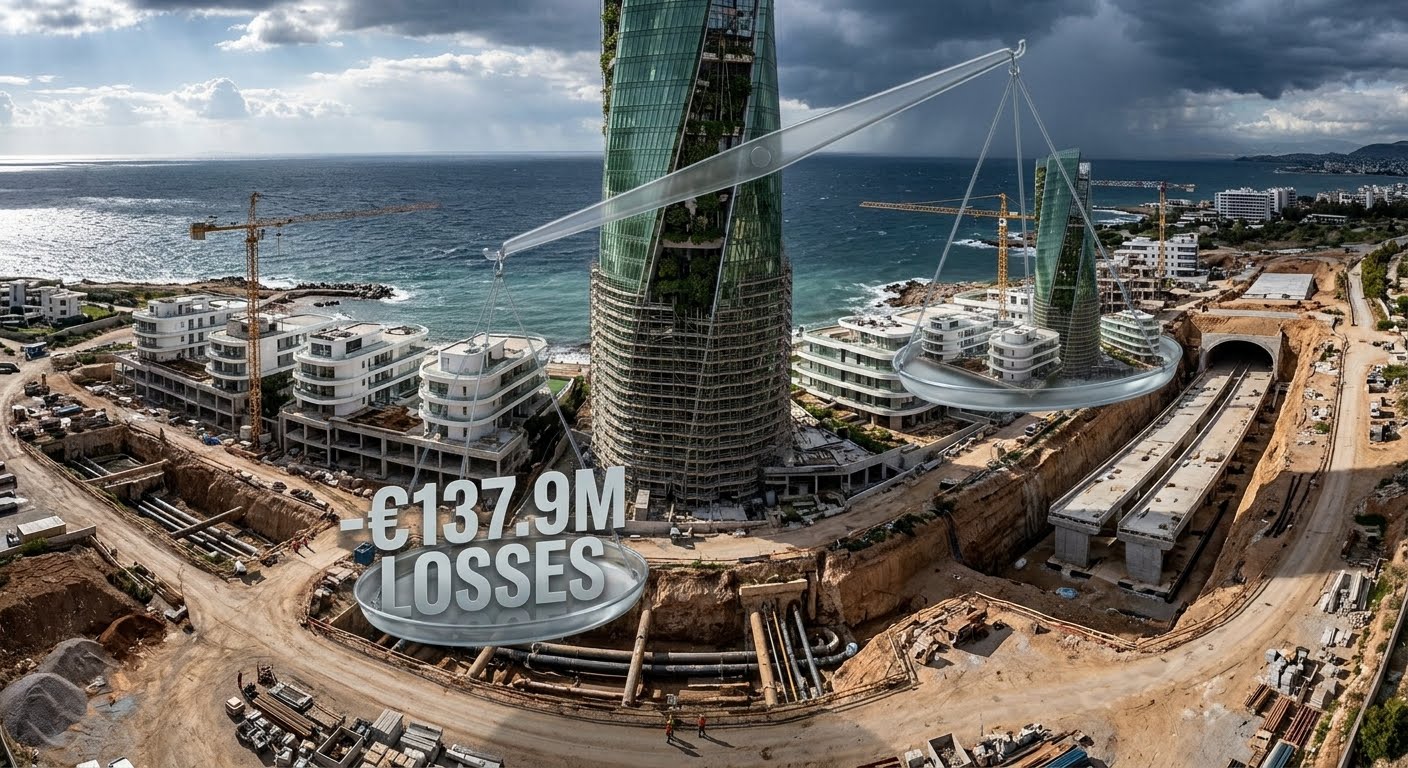
ATHENS, November 2026 — When LAMDA Development launched The Ellinikon urban regeneration masterplan, the project was marketed globally as the flagship symbol of Greece’s post-crisis economic renaissance—a self-funding, 6.2-million-square-meter coastal smart city whose initial Phase 1 milestones were projected for completion by late 2025. Today, as the development transitions from initial groundwork into its capital-intensive finishing phases, that original narrative is confronting severe financial, operational, and structural headwinds.
The resignation of long-serving CEO Odisseas Athanasiou—the chief architect of the project’s corporate and financial rollout—has rung loud warning bells across institutional markets regarding execution bottlenecks and internal cost overruns. A granular examination of LAMDA Development’s Nine-Month 2026 (9M 2026) financial disclosures reveals a tightening risk profile characterized by compounding delays, soaring administrative overheads, heavy debt service, and unfulfilled public infrastructure mandates. Left unchecked, these vulnerabilities pose not only an acute viability threat to the masterplan itself, but a systemic contagion risk to the broader Greek real estate market and national economy.
1. Flawed Initial Business Plan Assumptions and the Back-Loaded Cost Curve
In 9M 2026, LAMDA Development reported a consolidated group net loss of approximately €60 million, dragged down by a €137.9 million net loss and -€59.6 million pre-valuation EBITDA within The Ellinikon segment. These figures expose a fundamental miscalculation in the project’s initial business plan setup:
-
- The 60%–70% Finishing-Phase Cost Trap: In complex residential and commercial construction, structural concrete shells typically account for only 25%–35% of total expenditure, whereas mechanical, electrical, and plumbing (MEP) systems, facades, vertical transportation, and luxury interior fit-outs absorb 60% to 70% of total CapEx. By pre-selling Phase 1 flagship coastal properties (such as the Riviera Tower and Cove Residences) early at fixed prices to self-fund initial excavation and concrete frames, LAMDA left its balance sheet exposed to multi-year construction inflation during the most expensive phases of delivery. The resulting margin compression is already reflected in the €60.1 million in property revaluation and impairment losses booked at The Ellinikon in 9M 2026.
- Labyrinthine Administrative Overheads: Rather than demonstrating economies of scale, operating and administrative expenses specifically tied to The Ellinikon surged 35% year-on-year to €69.3 million in 9M 2026—an annualized burn rate exceeding €90 million. A sprawling, multi-layered corporate and project management apparatus has created rigid fixed overheads that erode gross operating margins well before properties are handed over.
2. Key Financial & Risk Metrics (9M 2026 Snapshot)
| Financial / Operational Metric | 9M 2026 Reported Figure | Structural Risk & Viability Implication |
|---|---|---|
| The Ellinikon Segment Net Loss | -€137.9 million | Driven by construction cost inflation, impairment charges, and high OPEX. |
| The Ellinikon Segment OPEX | €69.3 million (+35% YoY) | Annualized administrative burn rate >€90M consumes gross operating profits. |
| Group Gross Borrowings / Net Debt | €1.57 billion / €842 million | Driven by €850M in 2025–2026 bonds and up to €670M in mall project loans. |
| Group Finance Costs (9M 2026) | €84.4 million | Annualized >€110M interest burden absorbs nearly all mature mall/marina EBITDA. |
| Remaining Public Infrastructure Liability | €641.9 million | Back-loaded, non-revenue-generating public works owed under State concession. |
| Deferred Land Consideration to State | €402.7 million | Remaining balance from low initial acquisition price still owed to HRADF/TAIPED. |
| Group Cash / Undrawn Credit Lines | €726 million / €232 million | Short-term liquidity buffer shrinking as expensive finishing CapEx peaks. |
The figures in the Key Financial & Risk Metrics (9M 2026 Snapshot) table were sourced directly from LAMDA Development’s official Nine-Month 2026 financial disclosures, published on November 4–5, 2026
3. Unfulfilled Public Regeneration Commitments and the Utility Bottleneck
A foundational justification for the Greek State’s approval of The Ellinikon concession—and the primary rationale behind the low initial land acquisition price granted to the developer—was LAMDA’s binding contractual commitment to construct and deliver massive public-benefit urban regeneration works free of charge.
Out of €1.405 billion in cumulative CapEx spent on The Ellinikon through September 2026, capital deployment has overwhelmingly prioritized private, revenue-generating residential and retail builds over public infrastructure. LAMDA still carries €641.9 million in remaining contractual liabilities for public works—including the Poseidonos Avenue underground tunnel, flood-protection networks, and metropolitan park infrastructure—much of which remains stalled or embroiled in public cost disputes.
Furthermore, even as Phase 1 residential handovers slip 12 to 18 months behind the initial late-2025 target into spring/summer 2027, physical completion does not equal real habitability. In Greece, obtaining permanent electricity connections (via HEDNO/DEDDIE) and water/sewerage hookups (via EYDAP) routinely takes 6 to 12 months after official building completion. At The Ellinikon, this bureaucratic lag is exacerbated by severe off-site grid deficits: state water utility EYDAP was forced to announce an urgent €23 million network expansion in November 2026 specifically because existing southern coastal pipes cannot handle the projected influx of 40,000 residents and workers. Consequently, early buyers will likely wait until late 2027 or 2028 for full utility functionality—only to live inside isolated enclaves surrounded through 2036–2037 by a 6.2-million-square-meter heavy construction site plagued by noise, dust, and industrial traffic.
4. Compounding Interest, Active Penalties, and the 15% Tax Shock
To bridge the cash flow gap between surging finishing expenses and delayed milestone collections, LAMDA has issued €850 million in new corporate bonds across 2025–2026, pushing group gross debt to €1.57 billion and annualized finance costs above €110 million—an interest drain that consumes almost the entire cash EBITDA generated by its four existing shopping malls (€75.0 million) and Flisvos Marina (€15.5 million). Simultaneously, as schedules breach initial late-2025 targets, contractual grace periods are expiring, triggering active delay penalty exposure and stalling milestone-linked buyer installments.
This financial squeeze coincides with a sharp deterioration in external market conditions:
-
- End of the Greek Real Estate Boom: Bank of Greece data shows residential price appreciation decelerating from 8.3% in 2025 to 5.5% in Q2 2026, signaling a maturing cycle with limited capacity to absorb LAMDA’s €9,400–€10,600+/sq. m. pricing.
- Law 5355/2026 (The 15.45% Non-EU Transfer Tax): Enacted on November 13, 2026, and effective July 1, 2027, the Greek government has raised the residential transfer tax from 3.09% to 15.45% (including municipal surcharges) for non-EU/EEA individual tax residents. Because the tax is triggered by the final notarial purchase deed rather than a preliminary reservation, any construction or utility permitting delay pushing closings past June 30, 2027, imposes a fivefold tax surcharge on foreign buyers (over €123,000 in extra upfront tax on a €1 million property), threatening sales velocity and forcing price concessions.
5. The Systemic Contagion Scenario and the Case for State Oversight
While LAMDA’s €726 million cash reserve and €232 million undrawn credit facility provide short-term runway to finish Phase 1, analysts must weigh the tail-risk scenario: what happens if The Ellinikon stalls or fails financially mid-masterplan?
Because The Ellinikon is the single largest foreign direct investment (FDI) showcase in modern Greece, a severe restructuring, prolonged freeze, or default would trigger systemic shockwaves across the national economy:
-
- Real Estate Market Contagion: A distress sale or indefinite freeze of unfinished towers along the Athens Riviera would shatter investor confidence, depress collateral valuations across Attica, and abruptly reverse Greece’s post-2018 property recovery.
- Banking Sector & Capital Market Spillover: Greek systemic banks hold hundreds of millions of euros in project credit lines, VAT facilities, and corporate bond exposure tied to LAMDA, while thousands of domestic retail investors hold its ATHEX-listed bonds and shares. A credit event would tighten lending conditions across the entire Greek construction and corporate sector.
- Sovereign Reputation Damage: Having promoted The Ellinikon to global institutional funds as proof of Greece’s administrative and economic turnaround, an incomplete or abandoned mega-site on the Athenian coastline would inflict lasting reputational damage on Greece’s sovereign investment profile.
Given this profound public and macroeconomic exposure, mega-concessions built on public land and low initial acquisition prices cannot be left to opaque corporate self-regulation. Rigorous, continuous government monitoring is essential—not merely to audit corporate balance sheets, but to enforce strict capital allocation between private builds and mandatory public regeneration works, verify utility and infrastructure readiness, and guarantee that contractual deadlines and financial commitments are honored before public trust and international credibility are compromised.
Article by Kioleoglou Kosta
Civil Engineer Meng / Msc Real estate Investment and Finance
REV Valuer
