Greece’s 15% Property Transfer Tax in 2027: Who Pays and What It Costs
By Konstantinos Kioleoglou, for PropertyInvestmentnews.com
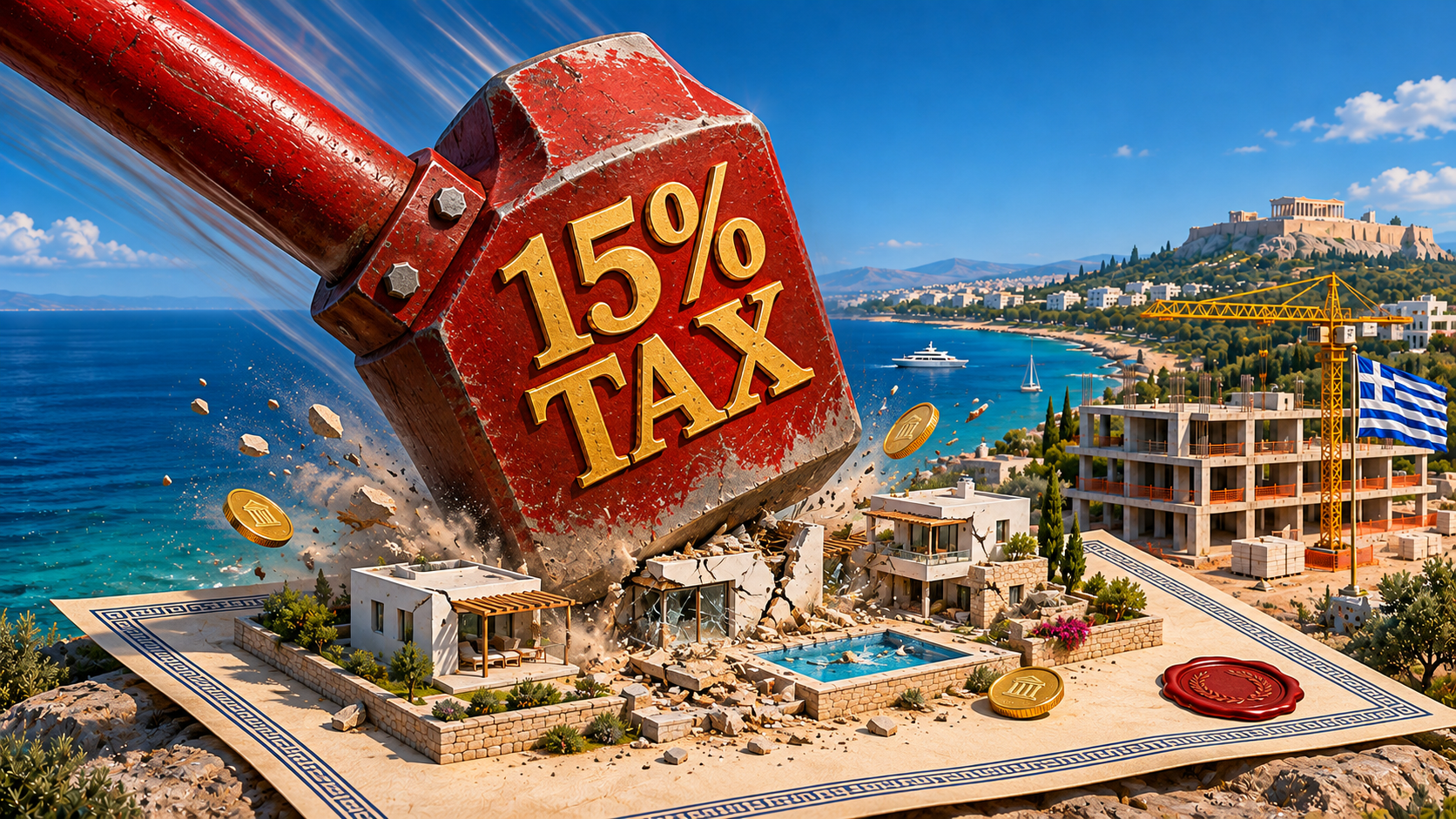
From 1 July 2027, Greece’s residential property transfer tax rises from 3% to 15% for affected individuals who are tax resident outside the EU and EEA. The final purchase deed determines which rate applies. On a €5 million home, the increase adds €618,000 where the municipal levy applies and the taxable value equals the purchase price.
Greece has spent the past decade establishing itself as one of Europe’s leading destinations for prime residential investment. The Athens Riviera has become a market in its own right, offering Mediterranean waterfront living within reach of a capital city, an international airport and year-round services. The Cyclades and the Ionian Islands have also attracted international capital into holiday homes, renovations and new residential development. From 1 July 2027, the Greek government will make it considerably more expensive for a significant group of international buyers to invest in these markets. The government should be able to explain what Greece gains in return.
Who pays Greece’s 15% property transfer tax?
Article 16 of Law 5355/2026, published in Government Gazette A′ 188 on 13 November 2026, raises the base transfer tax from 3% to 15% of the taxable value when an individual who is tax resident outside the European Union and the European Economic Area buys a residence in Greece. Article 53(8) applies the higher rate to final purchase deeds executed on or after 1 July 2027. A purchase otherwise subject to the standard rate must close by 30 June 2027 to retain that rate. A reservation agreement or deposit paid before the deadline does not secure it. Government Gazette, Law 5355/2026
The test is tax residence when the liability arises. A Greek citizen who is tax resident in the United States can fall within the higher rate, while a US citizen who is tax resident in France falls outside it on that basis. The law expressly excludes buyers who qualify for the first-home exemption under Article 42 of the Property Tax Code. A Golden Visa application or permit provides no separate exemption. Buyers considering new builds or conversions should confirm the property’s classification and applicable transfer tax or VAT treatment with their Greek notary.
How much is Greek property transfer tax?
The municipal levy is 3% of the transfer tax itself. Including it, the effective rates are 3.09% and 15.45% where the levy applies. The examples assume that the taxable value equals the purchase price and exclude other closing costs. www.aade.gr
| Taxable property value | Tax and levy at the standard rate | Tax and levy at the higher rate | Additional cost |
|---|---|---|---|
| €250,000 | €7,725 | €38,625 | €30,900 |
| €500,000 | €15,450 | €77,250 | €61,800 |
| €1,000,000 | €30,900 | €154,500 | €123,600 |
| €2,000,000 | €61,800 | €309,000 | €247,200 |
| €5,000,000 | €154,500 | €772,500 | €618,000 |
A €500,000 apartment generating €20,000 a year in gross rent yields 3.88% on the purchase price plus transfer tax and levy at the standard rate. At the higher rate, that falls to 3.46%, before financing, maintenance, vacancy or other expenses. At €5 million, a buyer would need to resell at €5,772,500 simply to recover the purchase price, transfer tax and levy, before any other costs and excluding any rental income received during ownership.
That is how government policy can make an otherwise attractive property artificially less competitive. The home generates the same rent and offers the same amenities, while the buyer must commit considerably more capital up front. In Greece Sotheby’s International Realty’s 2026 luxury-market survey, 63% of international respondents said they were considering at least one other country. When buyers have credible alternatives, a tax of this size can decide which country gets the investment.
What the tax means for the Athens Riviera, Cyclades and Ionian Islands
The Athens Riviera still offers, in my view, some of Europe’s strongest opportunities for long-term capital appreciation in prime coastal property. Glyfada, Voula and Vouliagmeni combine a functioning year-round market with features that are hard to reproduce, particularly lasting sea views and walkable access to the waterfront. The Ellinikon adds potential as parks, public spaces and commercial amenities come into use. The wider Athens dwelling price index roughly doubled in nominal terms between 2017 and 2025, and Athens apartment prices were still rising by 5.0% year on year in the second quarter of 2026. On the Riviera, a selected sample of 44 luxury listings had a median asking price of about €10,200 per square metre at mid-2026. For investors, the question is how much of the future upside is already priced in and how much the higher entry cost absorbs.
The exposure extends well beyond Athens. The Cyclades and the Ionian Islands have attracted international investment for years, from Paros and Mykonos to Corfu and Lefkada. The 2026 Sotheby’s survey put the Ionian Islands first among its international respondents’ destination preferences, at 26%, followed by the Cyclades at 20% and the Athens Riviera at 15%. These are survey preferences, and they illustrate how widely prime international demand is distributed. An owner trying to sell a villa in Corfu and a developer financing a small residential project on Paros can both feel the effects of the same tax.
Do foreign property buyers compete with Greek households?
Greece’s statistical authority, ELSTAT, recorded 122,123 real estate sale deeds in 2023 and 145,765 in 2024. Those totals include different property types, and a deed can cover several properties or a fractional interest. The government has estimated that about €800 million of property investment from third countries in 2025 went into residences. That is a measure of value. It cannot establish how many homes changed hands or what share of annual home sales the higher rate would reach. This is precisely the breakdown the finance ministry should publish before asking the market to accept its case for a blanket tax.
What the available transaction evidence does show is the importance of holiday and second-home demand. In RE/MAX Greece’s 2025 network data, 52% of foreign-buyer transactions were for second or holiday homes, 30% for investment, 10% for a primary residence and 8% for Golden Visa purposes. That sample also shows why precision matters. Typical purchases in the network were 60–100 square metres and €100,000–€200,000, while prime-market research identifies a separate international clientele for higher-value residences, including large villas. The evidence supports the importance of holiday-home demand and the existence of a distinct luxury segment. It also shows that some international buyers purchase the sort of modestly priced property that can overlap with local demand.
My judgement is that discouraging purchases of large villas and high-end second homes will do little to improve the nationwide availability of affordable primary housing. A multimillion-euro seafront residence remains beyond the reach of an ordinary household even if the seller substantially reduces the asking price. In an island town with scarce year-round rentals, however, a modest home bought for seasonal use can matter a great deal. The housing question is where international demand competes with local households for the same stock, at what price and in what numbers. A uniform national tax does nothing to distinguish those situations.
How the tax could affect Greek property prices, construction and jobs
The buyer pays the tax, but a Greek seller may absorb part of it through a lower offer. A buyer with €515,450 available for the price and transfer tax can pay €500,000 at the standard rate. At the higher rate, the same budget supports an offer of about €446,500, assuming the taxable value equals the agreed price. Where buyers have alternatives and sellers have few competing offers, the adjustment can come through lower prices, longer marketing periods or fewer completed sales.
The broader economic risk arises when slower sales change developers’ decisions. A project that misses its pre-sale targets may be phased, redesigned or deferred. That affects site workers, specialist trades, engineers and architects directly. It also means fewer orders for building-material wholesalers, concrete and steel suppliers, window and kitchen manufacturers, equipment rental firms and hauliers. Agents, valuers, lawyers and notaries feel the effect when transactions fall through. On smaller islands with fewer alternative projects, the loss of a single development can cut working hours and hiring across several businesses. If the slowdown is sustained, it can put upward pressure on local unemployment and reduce the number of homes built or renovated. The national scale of that effect is exactly what the government should have modelled.
Minister Kyriakos Pierrakakis and the government owe the market an answer
Kyriakos Pierrakakis, Greece’s Minister of Economy and Finance and President of the Eurogroup, should publish the assumptions behind the 15% rate. How many homes does the government expect to become affordable, in which municipalities and at what cost to development, employment and tax receipts? A credible revenue estimate must allow for some transactions being brought forward, renegotiated or abandoned. Net receipts from non-resident property purchases had already fallen 25.3% in 2025, to about €2.06 billion. The European Commission’s November forecast projects growth slowing from 1.8% in 2026 to 1.5% in 2027, even as unemployment and public debt continue on a projected downward path. Against an international energy shock and ahead of the expected spring 2027 election, the Mitsotakis government should be defending Greece’s economic gains with a published assessment of the trade-offs. In my view, legislating a fivefold increase in the base rate without a convincing public case for the housing benefit is a serious policy error.
The Ellinikon illustrates why the timing matters. LAMDA Development reported a €137.9 million after-tax loss for the project in the first nine months of 2026, compared with a €2.3 million loss a year earlier, even as residential sales revenue increased 27%. Higher operating expenses and adverse valuation movements weighed on those results, which predate the new law. The figures show how a strategic development can have healthy residential demand while facing considerable financial pressure. Before making homes more expensive for part of the international buyer pool, the government should explain what it expects weaker or slower pre-sales to do to construction schedules, supplier orders and jobs.
What should international buyers check before paying a deposit?
For buyers already considering a purchase, the immediate priority is to confirm the taxable value, tax treatment and realistic date of the final deed before paying a deposit. If completion could slip past 30 June 2027, calculate returns at the higher rate and check how the agreement handles any delay.
Greece should amend Article 16 before it takes effect
A defensible housing measure would start with local evidence on completed sales, buyer tax residence, price bands and intended use. Where the data show direct competition for homes Greek households can afford, a targeted intervention may have a case. Government policy should also make it easier to bring vacant homes back into use, restore listed buildings, convert suitable commercial space and finish new housing through faster approvals and utility connections. These measures address the shortage of homes people can actually occupy.
Greece has a warning from its own history. VAT on qualifying new buildings took effect on 1 January 2006, ahead of the 2007–08 market peak. Housing investment then suffered a prolonged collapse. The global financial crisis, Greece’s sovereign-debt crisis and the contraction in bank lending were major drivers. The lesson for today is that a government can compound an external shock by adding costs to a market whose investment and employment are already exposed. Once projects are shelved, firms lose capacity and skilled workers move on, rebuilding takes years.
The only way to correct a policy mistake is to recognise it early and amend it before the damage is done. The government still has time to revise Article 16 before 1 July 2027. Greece should use that time and avoid repeating the mistakes of the past.
Konstantinos Kioleoglou, MEng, MSc, REV, is a civil engineer and Managing Partner of AVAKON Real Estate Development. He holds an MSc in Real Estate Investment and Finance.